Vulnerability Management
The Rise of Autonomous Pentesting: How AI Agents Are Reshaping Cybersecurity in 2026
Legacy DAST scanners are hitting their limits. Here's how autonomous AI agents pentest 80x faster, cut false positives by 90%, and validate exploits automatically.
Dedcell Security · · 10 min read
THE OLD GUARD IS RUNNING OUT OF RUNWAY
Imagine a security guard assigned to protect a sprawling mansion. His job is to test every door, window, and lock to find weaknesses. He works methodically, checking each entrance, trying thousands of key combinations, documenting everything he finds.
He’s thorough. He’s reliable. He’s also exhausted.
That guard is essentially what DAST scanners (Dynamic Application Security Testing) have been doing for 20+ years. They crawl through applications, inject thousands of test payloads, and report what breaks. It worked brilliantly when applications were simple. Your website had a login page, a product catalog, maybe a shopping cart.
But applications aren’t simple anymore.
Modern software is a labyrinth. Microservices talk to APIs. Serverless functions run in the cloud. AI-powered workflows execute continuously. GraphQL endpoints expose data. Real-time databases store sensitive information. Third-party integrations connect everywhere. The attack surface has exploded. Traditional scanners are still checking doors and windows, but the mansion now has 50 buildings, underground tunnels, and a network of hidden passages.
The result is that security teams are drowning in false alarms, missing real vulnerabilities, and spending weeks validating scanner alerts that turn out to be harmless.
Enter Agentic AI.
Instead of a methodical guard checking off a checklist, imagine an experienced penetration tester. This person understands application logic, adapts their strategy in real-time, and hunts for novel attack patterns. That’s what autonomous AI agents do. They reason. They learn. They validate. And they operate 80x faster than legacy scanners.
This isn’t a marginal improvement. It’s a fundamental reset of how offensive security works.
Traditional DAST tries everything. AI agents strategize intelligently.
Why Legacy DAST Is Hitting Its Limits
The Problem With Brute Force
Remember that exhausted security guard checking every door? Here’s the real problem: he can’t think.
He doesn’t know if a door leads to a warehouse or a safe. Doesn’t matter — he tries every key anyway. He’s not strategizing. He’s just executing a checklist.
That’s exactly how traditional DAST scanners work.
How Legacy DAST Actually Works (Simple Version)
Here’s the typical flow:
- Crawl → Scanner visits every page of your application
- Enumerate → Lists all forms, buttons, and input fields
- Inject Payloads → Throws thousands of test strings at every input (same payloads, every time)
- Analyze Responses → Looks for patterns that indicate a vulnerability
- Report → Sends you a list of alerts (many false)
The math gets brutal quickly:
Imagine your application has:
- 1,200 endpoints (web pages/API routes)
- 5 input fields per endpoint (forms, search boxes, filters)
- 10,000 test payloads (variations for SQL injection, XSS, etc.)
Your scanner attempts: 1,200 × 5 × 10,000 = 60 million requests
That’s 60 million tests. On a slow or complex application? We’re talking days or weeks of scanning.
Here’s the Kicker: 90% of Those Tests Are Pointless
The scanner doesn’t understand your application. It doesn’t know if an endpoint connects to a database, so it wastes time on SQL injection tests even when there’s no database to inject. It doesn’t know a field only accepts numbers, yet it still tests for XSS on a zip code field. It doesn’t know an API requires authentication, but it tests without logging in first. It doesn’t know a parameter is never used, but it tests it anyway.
It’s like sending someone to test every window in a building without telling them which rooms exist or what they contain.
The False Positive Nightmare
Here’s what kills security teams’ productivity:
A DAST scanner flags something suspicious. Looks like a potential SQL injection vulnerability. The security engineer investigates for 2 hours. Turns out it’s a false positive — the application was just logging the request, not executing it.
And this happens hundreds of times.
Let’s use actual math (Bayes’ Theorem):
Assumptions:
- Real vulnerabilities in your app: 1% of alerts
- Scanner correctly identifies real issues: 95% accuracy
- Scanner incorrectly flags normal behavior: 40% false-positive rate
The result? Only 2.3% of reported alerts are actually real vulnerabilities.
Translation: Security teams spend 97.7% of their time investigating false alarms.
Why Speed Matters (And Why DAST Fails)
Think about modern DevOps:
You’re deploying code multiple times per day. Every deployment should trigger a security scan. But if each scan takes 3–7 days, you can’t scan continuously. You’re choosing between:
Option A: Scan every deployment (security is slow, development stalls) Option B: Scan selectively (you miss vulnerabilities in code you skipped)
There is no good option.
This is why organizations are desperate for a faster approach.
Traditional DAST can’t keep up with modern development velocity. Vulnerable code slips through because scans take too long.
How Agentic AI Actually Works (The Different Approach)
Think Like an Attacker, Not a Scanner
The fundamental difference between DAST and Agentic AI isn’t speed. It’s intelligence.
When a human penetration tester walks into a security assessment, they don’t run 60 million random tests. They don’t report every suspicious behavior. They don’t stop after finding one vulnerability.
Instead, they observe the technology stack and authentication model. They plan by deciding, based on what they know, what the highest-value attack vector is. They execute that specific approach. They learn from failures and ask what the response tells them. They adapt by updating their hypothesis and trying a different angle. They validate by checking if they can actually exploit the vulnerability and get proof.
Agentic AI does exactly this - but at machine speed.
Breaking Down the AI Agent Architecture
An autonomous pentesting system has multiple specialized agents working in parallel. The Planner Agent reads the entire reconnaissance history and understands the technology stack, authentication, API structure, and access controls. It decides what to try next and prioritizes high-value attack paths.
Specialized Attacker Agents
- SQL Injection specialist
- XSS specialist
- Authentication bypass specialist
- SSRF investigator
- API abuse analyst
- Business logic analyzer
Each agent receives context from the planner, executes targeted tests rather than random payloads, shares discoveries with other agents, and automatically validates if an exploit actually works.
The Memory System stores all discoveries compactly, prevents context exhaustion, allows multi-hour attack chains, and enables other agents to learn from previous findings.
Why This Changes Everything
Traditional DAST: “Let me try 10,000 payloads against this field.”
Agentic AI: “Based on the response patterns, error messages, and backend behavior I’ve observed, this field likely uses PostgreSQL. Here are the 15 most effective PostgreSQL injection techniques for this specific scenario.”
Same goal. Completely different approach.
The result? 94% fewer HTTP requests. Better vulnerability detection. Higher-quality proof-of-concepts.
A Real-World Example
Imagine your application has JWT authentication, a GraphQL API, and role-based access control.
Traditional DAST would test every field independently, generate thousands of SQL injection payloads even for non-database fields, report suspicious responses without proof, take 5 days to complete, and result in 200 plus alerts with 190 being false.
Agentic AI:
- Reconnaissance agent decodes JWT, identifies role structure
- Discovers: User can see own data, but API doesn’t validate ownership
- IDOR (Insecure Direct Object Reference) specialist targets object IDs
- Automatically validates exploit: Changed user_id=1 to user_id=2, retrieved another user’s data
- GraphQL specialist tests for authorization bypasses in nested queries
- Takes 90 minutes
- Result: 4 confirmed vulnerabilities with proof-of-concepts
Autonomous agents reason and adapt. Each specialist focuses on high-probability attack paths, sharing discoveries in real-time.
Why This Matters for Your Business
Time Is Money (Literally)
Let’s talk about remediation costs. Traditional vulnerability management involves several stages. Scanning takes 5 to 7 days. Triage takes 2 to 3 days while a security engineer reviews 200 alerts and determines which ones might be real, costing roughly 200 to 300 dollars per engineer hour times 16 hours, which equals 3,200 to 4,800 dollars.
Verification takes 2 to 5 days while teams spend time confirming false positives and finding that many alerts turn out to be benign, costing 2,000 to 3,000 dollars more. Remediation varies wildly as developers fix confirmed issues, costing 1,000 to 10,000 dollars or more depending on severity.
Total time for one scan cycle is 10 to 20 days. Total cost is 6,000 to 18,000 dollars or more. And this doesn’t count the productivity loss for developers context-switching to address alerts.
The Agentic AI Model Cuts This Dramatically
Scanning & Validation (2–4 hours)
- AI validates vulnerabilities automatically
- No false positives cluttering the queue
- Engineers don’t waste time investigating ghosts
- Cost: $0 (AI does the work)
Remediation (varies by severity)
- Developers only fix confirmed vulnerabilities
- Fewer context switches
- Better prioritization (AI provides severity/impact data)
- Cost: 60–70% reduction vs. traditional approach
New cost model: $2,000–5,000 per scan (compared to $6,000–18,000)
New timeline: 1–2 days instead of 10–20 days
Continuous Security Becomes Realistic
Here’s what enterprise organizations actually want:
“Security scan on every deployment”
With traditional DAST, that’s impossible. You deploy 10 times per day. If each scan takes 5 days, you’d never catch up.
With Agentic AI:
- Deploy code → Automated scan starts immediately (2–4 hours)
- Scan completes before next deployment
- Vulnerabilities found and validated in real-time
- Developers fix issues before code reaches production
Result: Continuous security at enterprise scale.
The Zero-Day Problem
Here’s something DAST scanners fundamentally can’t do: discover unknown vulnerabilities.
Signature-based detection works for known vulnerabilities. “We’ve seen this SQL injection pattern before — flag it.”
But zero-day vulnerabilities don’t have signatures. By definition, they’re new.
Agentic AI approaches this differently. It doesn’t look for signatures. It reasons about application behavior.
Example:
- Discovers an unusual authorization pattern
- Infers: “User roles should restrict access, but this endpoint doesn’t validate role…”
- Constructs an exploit chain to prove it
- Finds a zero-day vulnerability that no signature database contains
This moves security from vulnerability detection → vulnerability discovery.
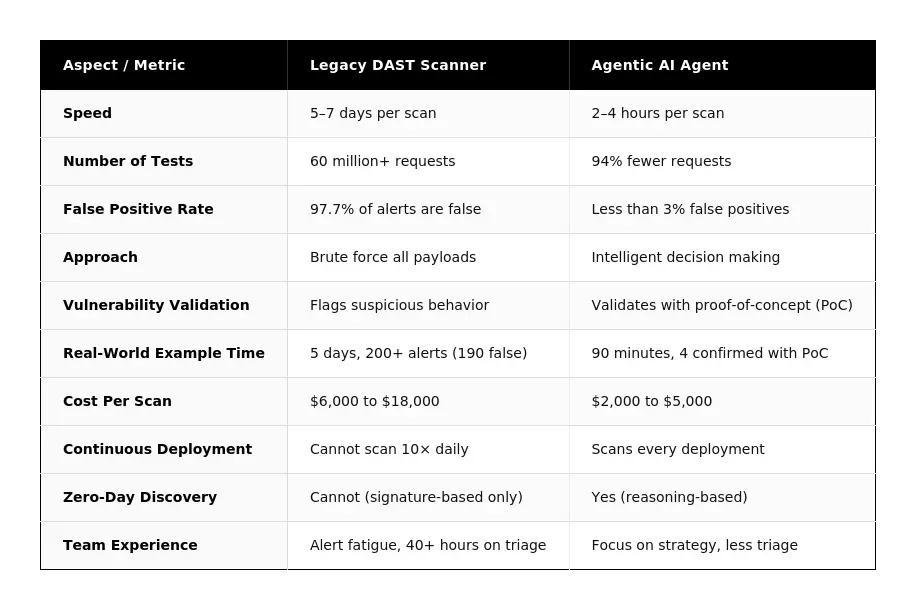
Side-by-side comparison of Legacy DAST scanners versus Agentic AI agents.
The Future of Offensive Security
This Is the Third Major Evolution
The history of cybersecurity is a history of automation replacing manual work.
Era 1 was Manual Security Testing before 2000, where consultants manually tested applications. It was slow and expensive but intelligent, and only accessible to enterprise budgets.
Era 2 was Automated DAST Scanners from 2000 to 2025, which democratized vulnerability detection. It was fast and cheap but not very intelligent. It generated massive false-positive noise and couldn’t discover novel vulnerabilities.
Era 3 is Autonomous Agentic AI starting in 2026 and beyond. It combines automation with reasoning. It’s fast and intelligent and cheap. It validates before reporting, discovers novel attack chains, and adapts in real-time.
This mirrors other major tech transitions. Static antivirus evolved into behavioral EDR. Manual log analysis evolved into SIEM. Rule-based alerts evolved into machine learning detection. Deterministic scanning is evolving into autonomous reasoning.
The pattern is always the same: add intelligence to automation.
What Happens Next?
Organizations adopting Agentic AI today will have a massive security advantage in 3–5 years because:
- Continuous scanning → They find vulnerabilities developers introduce, immediately
- Better prioritization → They focus remediation on confirmed, high-impact issues
- Lower costs → Security becomes an enabler, not a bottleneck
- Talent efficiency → Security teams spend time on strategy, not alert triage
Organizations still using DAST will:
- Struggle with scan backlogs
- Waste time on false positives
- Miss vulnerabilities during rapid deployments
- Burn out security teams on alert fatigue
The Adoption Curve
We’re at the inflection point right now (mid-2026).
Early adopters (now through 2027):
- Large enterprises with AppSec teams
- Financial services & compliance-heavy industries
- SaaS companies with continuous deployment
Early majority (2027–2028):
- Mid-market organizations
- Government agencies
- Healthcare organizations
Late majority (2028+):
- Smaller businesses
- Less compliance-heavy industries
If your organization is reading this in 2026, you have a 12–18 month window to evaluate and adopt before these tools become industry standard. Being early doesn’t provide just an advantage — it might be necessary to stay competitive.
The Real Disruption
The biggest disruption isn’t technical. It’s organizational. Traditional DAST created a specific role: the security alert triager. Someone spends 40 or more hours per week investigating whether scanner alerts are real.
Agentic AI eliminates that role entirely. Validated exploits don’t need triage. They need remediation. This means organizations will restructure their AppSec teams. There will be fewer analysts reviewing alerts, more specialists building secure architectures, more time on threat modeling and risk assessment, and less time on alert fatigue.
This is actually good news. It’s moving security from reactive responses to alerts toward proactive prevention of vulnerabilities before they exist.
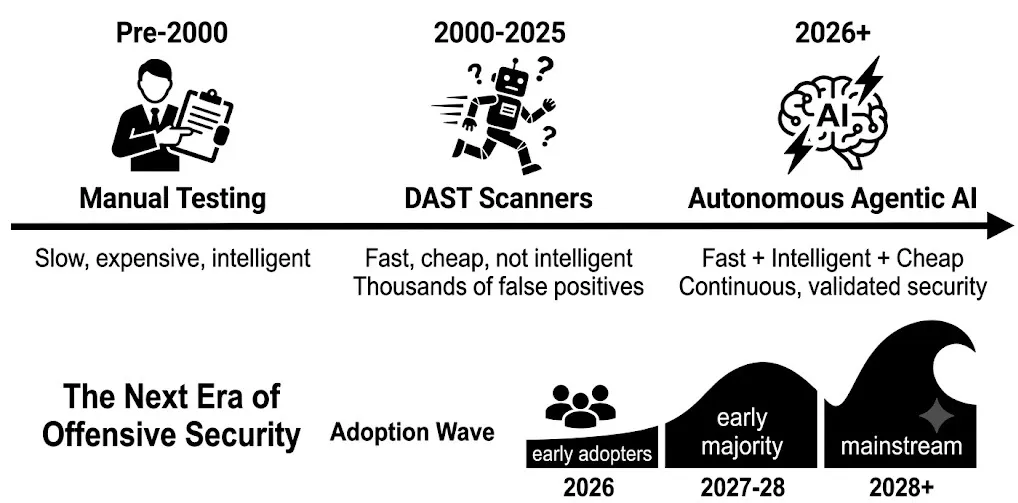
Security automation is entering its third era: intelligent, continuous, and scalable
Conclusion: The Era of Autonomous Pentesting Has Begun
Legacy DAST transformed application security by automating repetitive testing.
Agentic AI is transforming it again by automating intelligent reasoning.
The security team that adapts first gains an enormous competitive advantage:
- Faster vulnerability discovery → Get ahead of attackers
- Lower remediation costs → More budget for security strategy
- Better developer experience → Less alert fatigue, more trust
- Continuous deployment → No more security bottlenecks
As cloud-native applications continue exploding in complexity, as DevOps cycles accelerate, and as attack surfaces expand, the future doesn’t belong to scanners that try everything.
It belongs to intelligent agents that reason strategically.
That future isn’t coming in 2028 or 2030.
It’s already here in 2026.
The only remaining question is: How quickly will your organization adapt?